Form permission verification
Requirements: REQ-PRODUCT-FORM-PERMISSIONS, REQ-EU-CONSENT, REQ-CA-MEANINGFUL, REQ-EU-MARKETING, REQ-CA-CASL-OPTIN. Legal research links are contextual; the product mechanism does not certify regional compliance.
Automated tests exercise intact release/wording binding, independent archive reconstruction, stable purpose/channel/revision identities, preview gates, unchecked/absent-field behavior, no automatic reads or form submission, acknowledged grants, old-offer withdrawal, late first withdrawal versus historical retry, lost acknowledgments, grant/withdraw orderings, activation rollback, non-cookie scope guards, subject/contact/channel isolation, pending contact-change rejection, delivery windows, invalid requests/replies, monotonic response bounds across errors, cancellation before transport, hung transports and nonce-preserving retries, retirement/holds/purge isolation, minimized projections, and host-authorized export. Admin presentation is also checked for distinct historical/read-time state and both time sources.
The focused suite now also covers transactional IndexedDB recovery, two-connection serialization/abort, reload, volatile withdrawal, changed offers/artifacts/contacts, stale tabs, persistent high-water fences and keyboard continuity. Site integration tests cover signed session routing, separate contact-generation streams, scoped inspection/export, retirement, seed resume and a real-controller bootstrap whose initial read fails or never settles. Withdrawal remains usable in both cases; ordinary form submission makes no permission write.
The latest full project check passes 367 tests (324 package tests and 43 site tests), catalog validation, site generation and the Worker deployment dry run. Recovery and UX additions also have actual local Chromium verification.
Run npm run build, then node --test packages/notabenda/test/form-permission.test.mjs packages/notabenda-cf/test/lifecycle.test.mjs.
The optional local runtime check, node scripts/check-form-permission-runtime.mjs, passed against an isolated SQLite Worker: concurrent duplicate grants produce one event, crossed contact streams fail, withdrawal keeps old grant retries restrictive, inspection/export are session-scoped, public policy HTML remains script-free, and session/receipts/revision/state survive a process restart. It owns its loopback runtime and stores its disposable fixture under ignored .local/; it does not deploy.
Actual Chromium checks: light/midnight grant and withdrawal share the same session stream; the primary draft action leaves the saved revision unchanged; a changed offer does not inherit a prior grant. A historical grant detail after withdrawal shows the historical action beside the negative current evaluation. Searching withdrawn returns matching evidence. At 320px and 390px the public field and 320px admin search fit without horizontal document overflow; public input text is 16px and permission buttons are 46px tall. Acknowledged permission hides the grant draft instead of displaying an unchecked box beside an active grant.
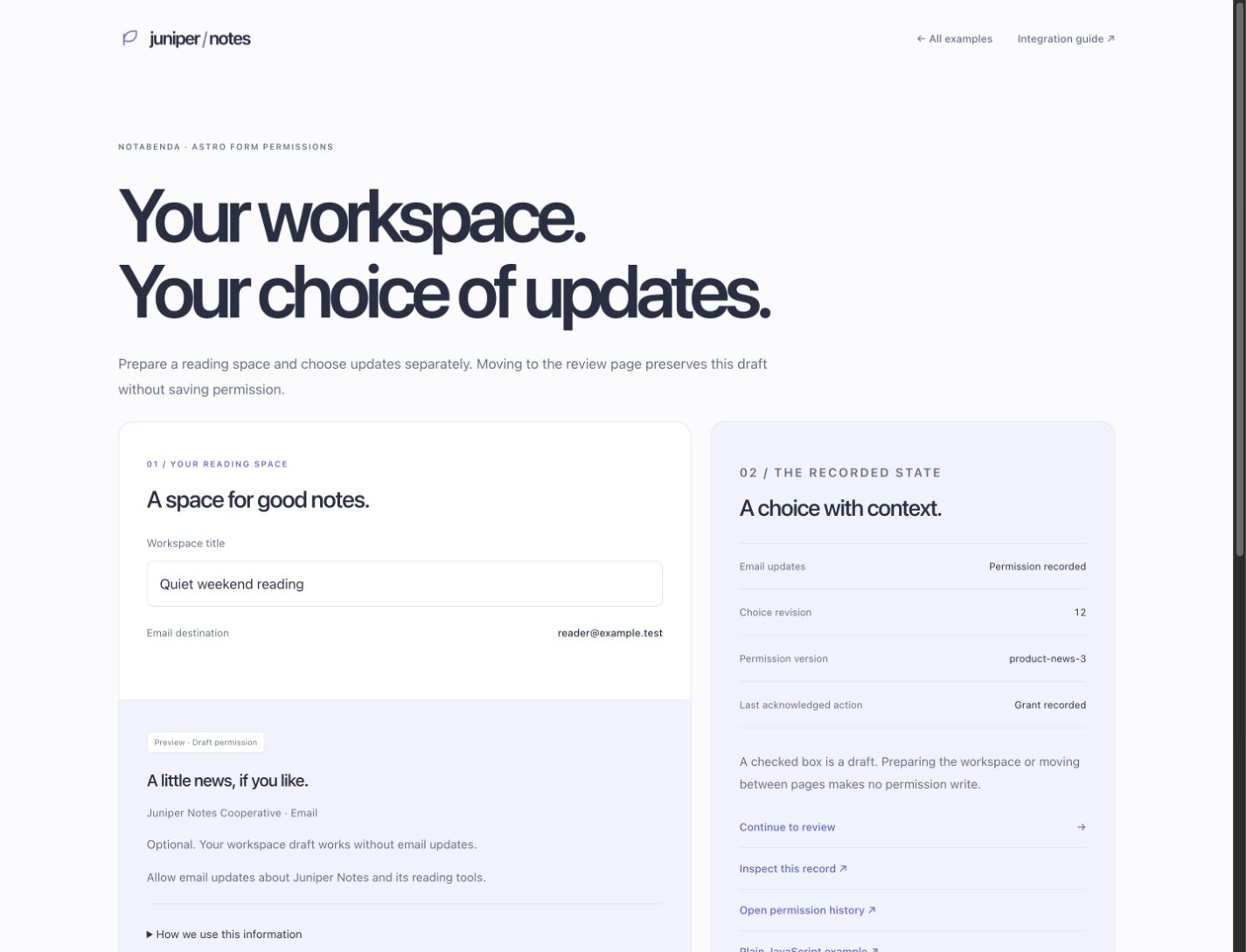
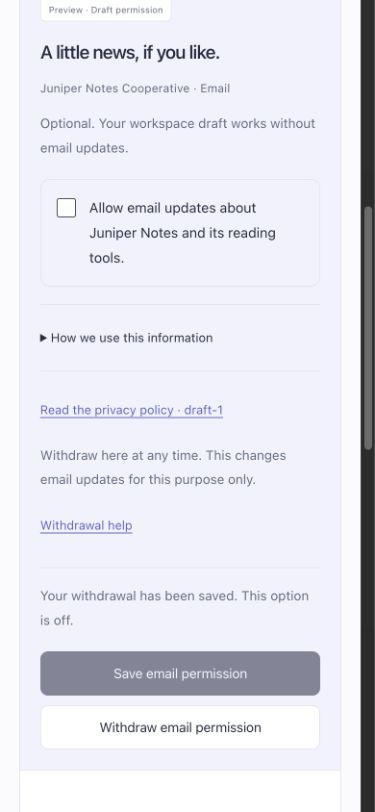
Screenshots: light, mobile, midnight, historical grant detail, mobile evidence search.
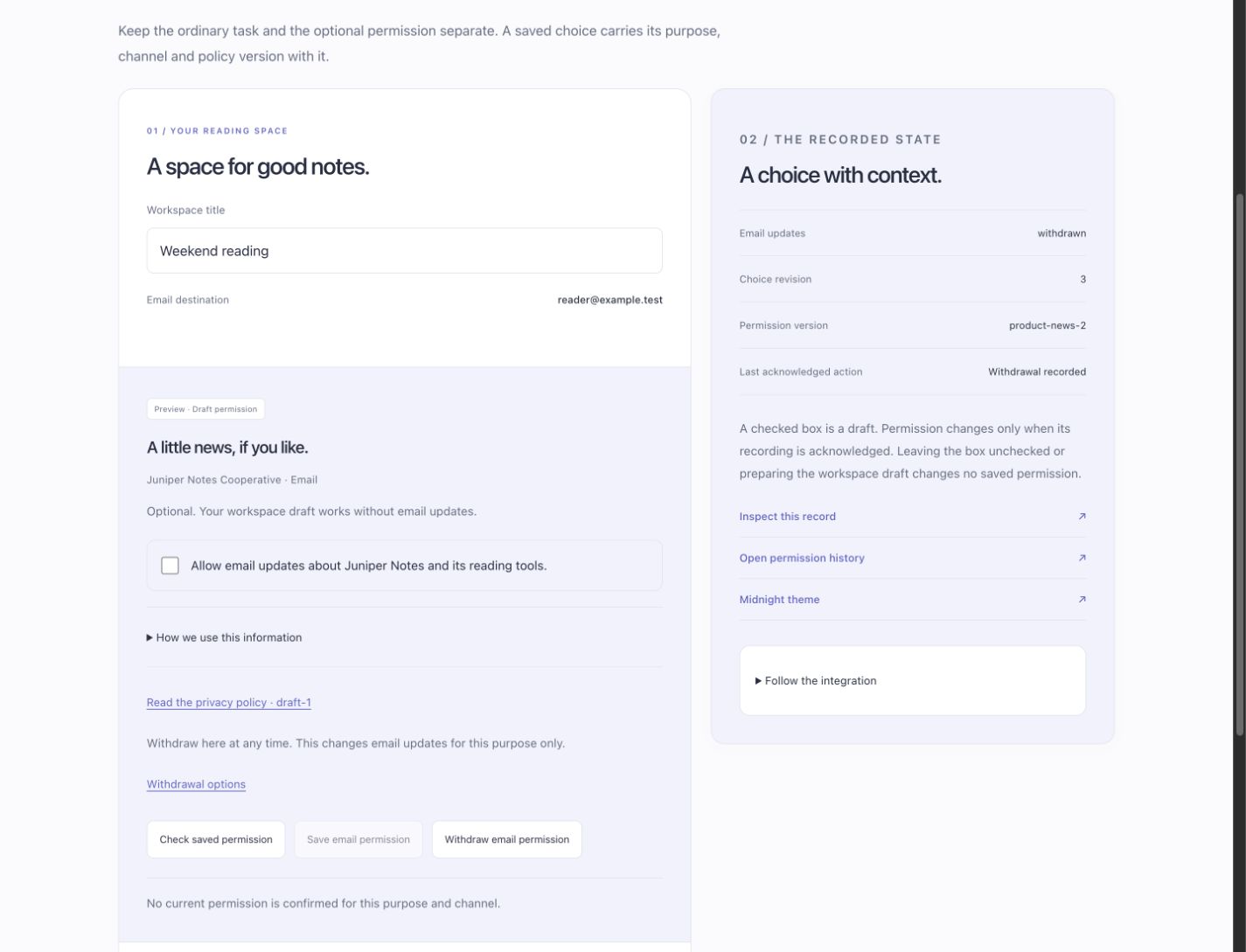
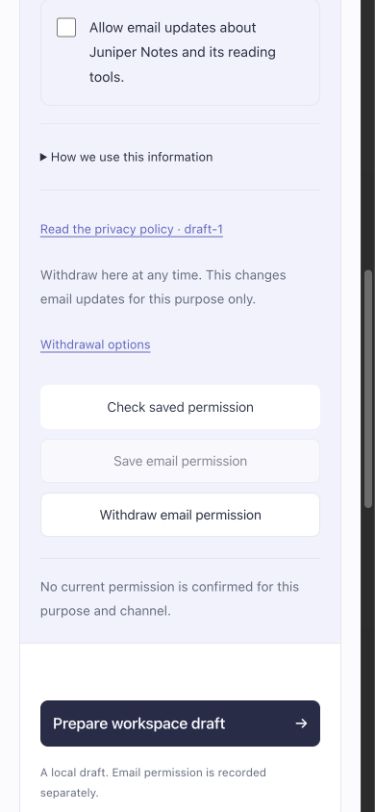
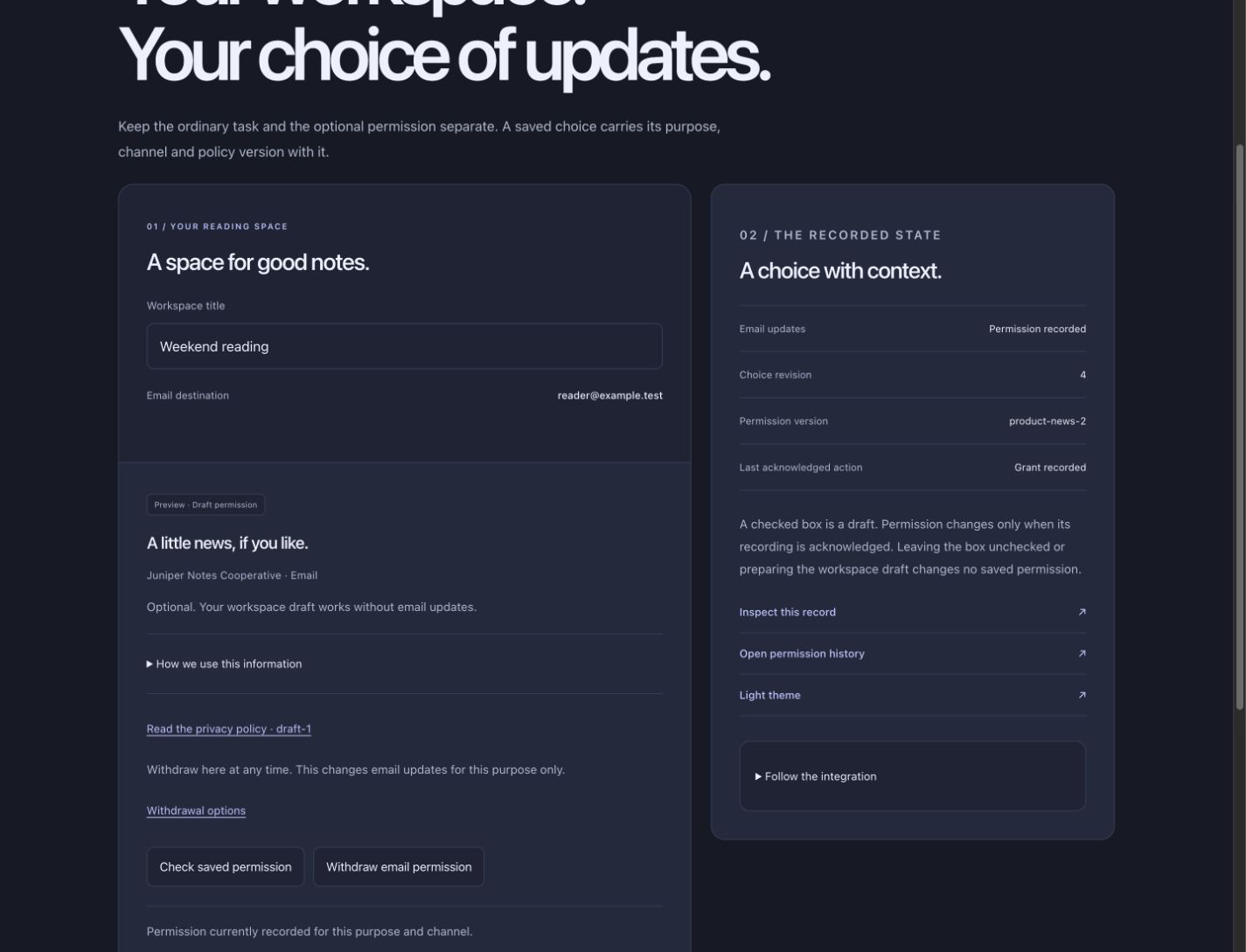
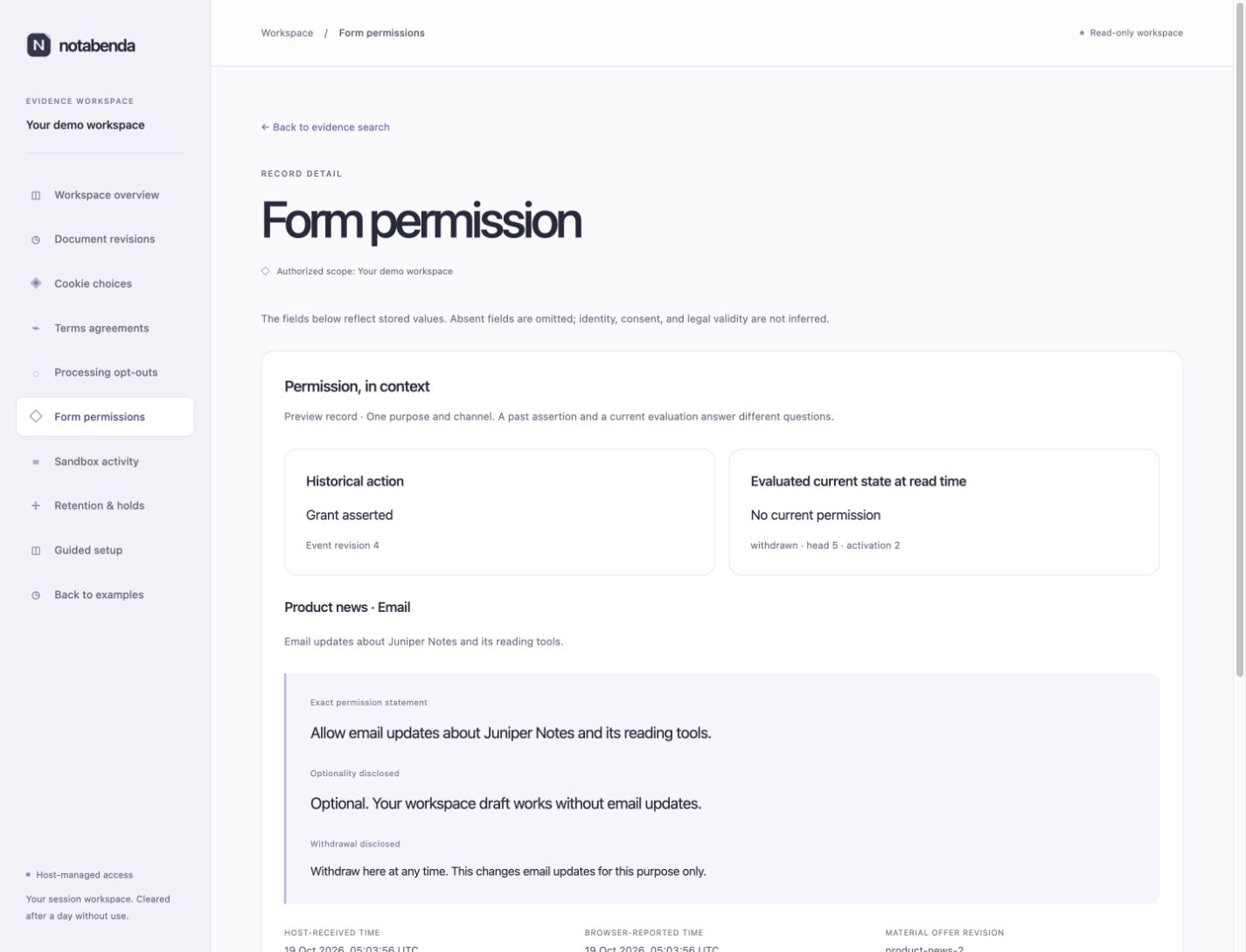
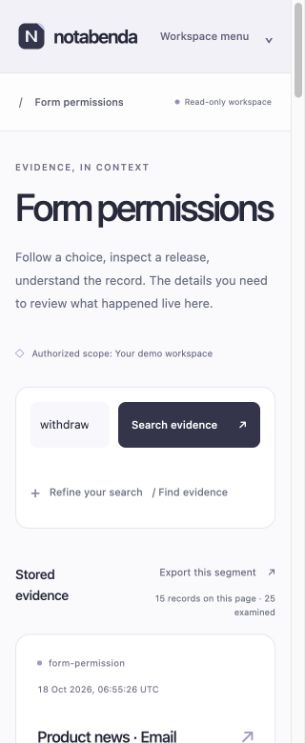
See the visitor/operator UX review for actual IndexedDB outage/reload/retry observations and interface changes.
Remaining acceptance work: automatic/background delivery, the complete accessibility/platform matrix, and regional legal/wording review. The checks above do not establish those items.
React field verification
packages/notabenda/test/react-form-permission.test.mjs verifies the provider/hooks/native field around the actual core controller and CF ledger: conservative SSR even with a recorded grant, matching hydration after an early host read, immutable cached snapshots, one StrictMode mount, cleanup without host destruction, no mount-time transport, unrelated form submission, controller replacement and exact pending-request retry after remount. react-package.test.mjs installs the tarball and type-checks the new exports, including nested read-only state. Site checks cover the real built light/midnight entry pages, local bundle, inert server markup and session-only host context injection.
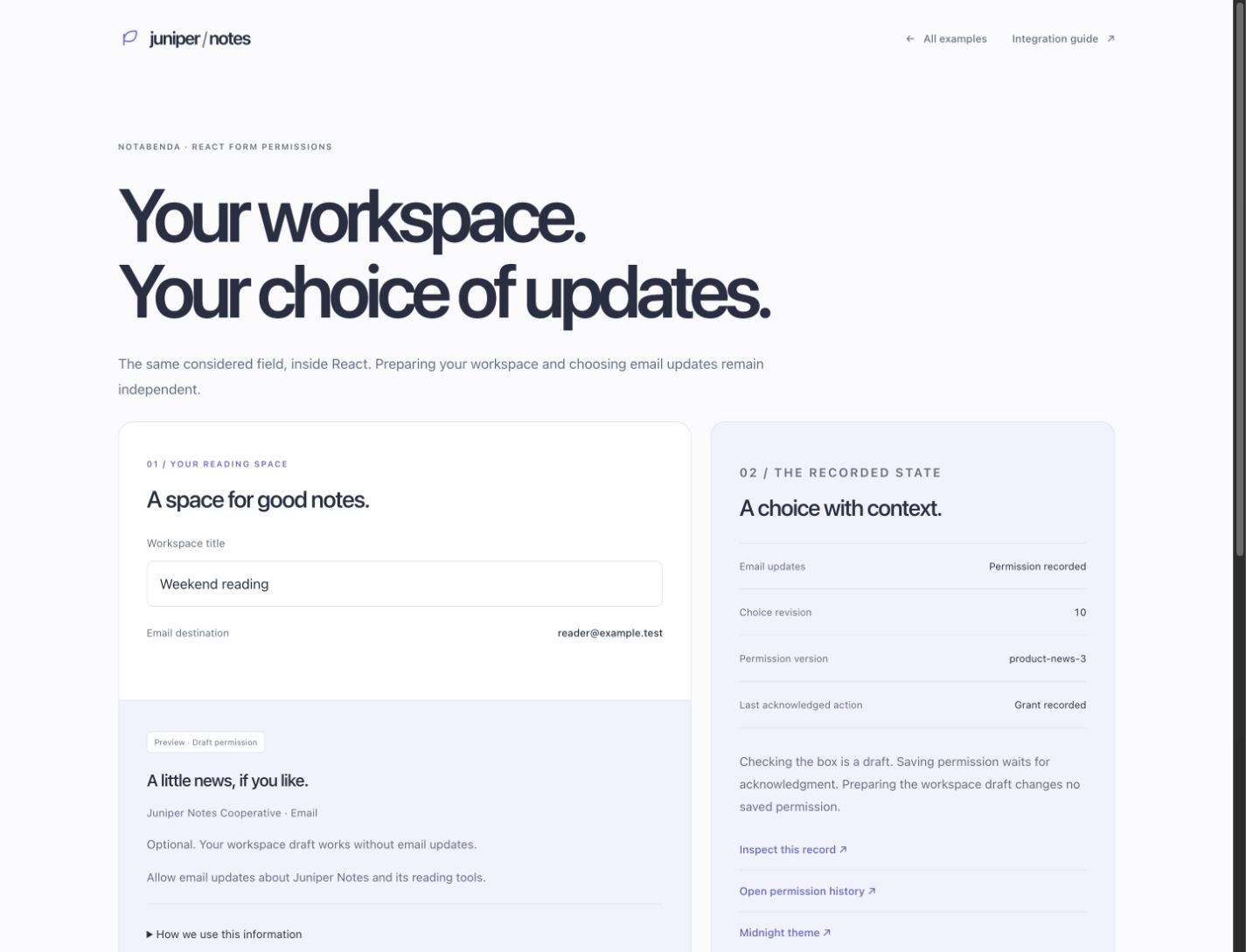
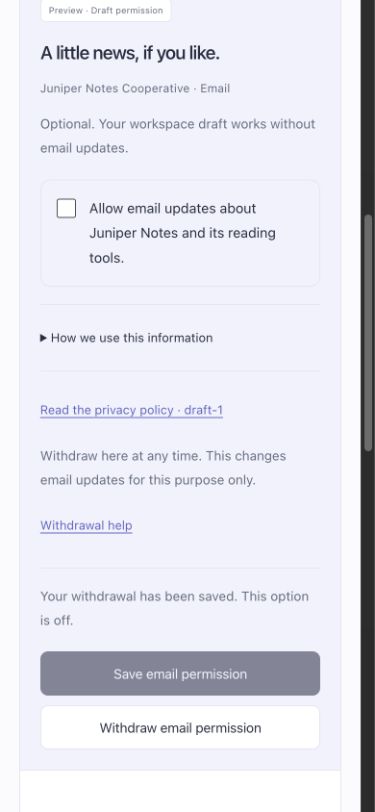
Actual Chromium verified the following on the SQLite-backed local site: a checked permission followed by workspace preparation kept revision 9 unchanged; explicit Save recorded revision 10 and moved focus to withdrawal; reload recovered that grant; mobile withdrawal recorded revision 11 with an unchecked draft; midnight recovered the withdrawn state at the same revision. At 320px there was no horizontal document overflow, the public text input remained 16px and both permission buttons were 46px tall. This is an initial Chromium check, not the broader platform matrix.
Screenshots: React desktop, React mobile withdrawal. The React guide documents ownership, SSR, fallback and explicit transport behavior.
Astro field verification
packages/notabenda/test/astro-form-permission.test.mjs exercises named mounts, repeated page loads, detach/remount, absent routes, draft retention without recording, duplicate-owner isolation, changed offers, cleanup and exact pending-request retry through navigation. The Astro tarball consumer compiles the static component and verifies its readable fallback without a framework/runtime dependency in default installs. Real Astro build checks include both permission routes, shared styling, empty server mounts, script-free policy pages and exclusion of the local draft form from router handling. site/test/astro-permission.test.mjs exercises the actual host bootstrap across repeated page loads and session/contact/offer replacement before bridge refresh.
Actual local Chromium observed a workspace title and checked draft persist from the first page to review while saved revision 11 stayed withdrawn. The browser caught Astro router interception of the local draft form; the form is now explicitly excluded, and a recheck kept its URL unchanged with no permission write. Explicit Save recorded revision 12, which survived navigation to review; mobile withdrawal recorded revision 13. At 320px there was no horizontal document overflow, the text input was 16px and permission buttons were 46px tall. These observations use the local SQLite-backed isolated session and do not establish the wider accessibility/platform matrix.
Screenshots: Astro desktop, Astro mobile withdrawal.